
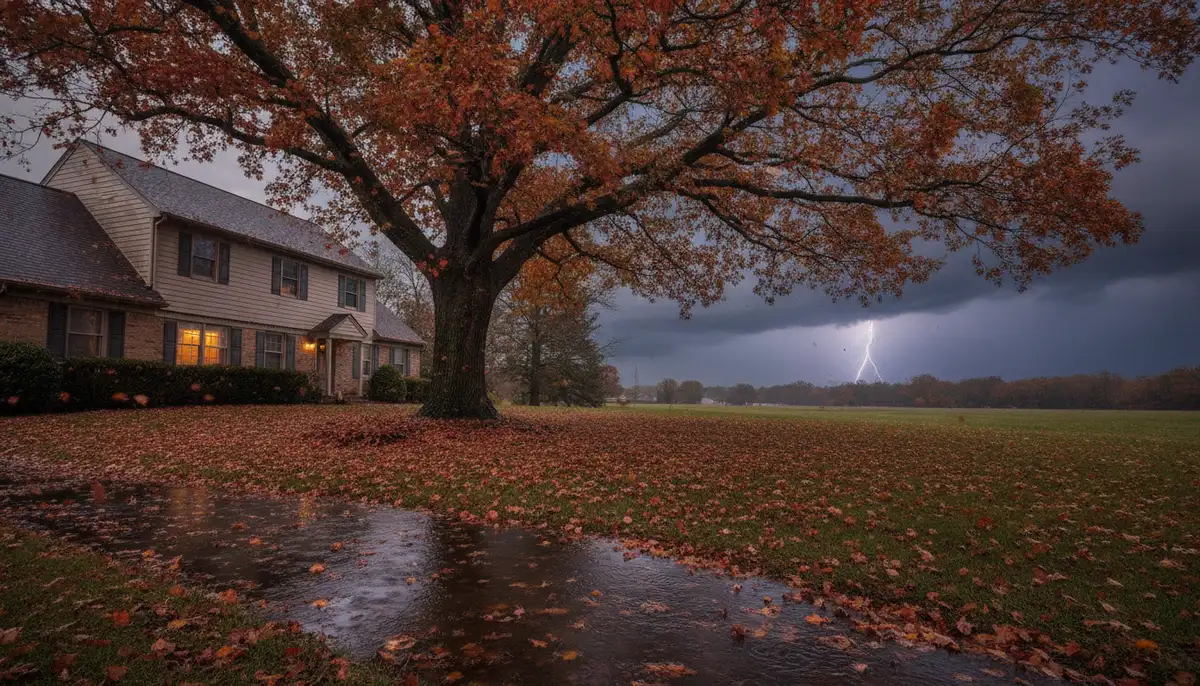
The Science of Fall Storms: Why Leafy Canopies and Wet Soil Threaten Your Property
As the vibrant colors of autumn begin to transform the landscape, homeowners often find themselves admiring the seasonal shift. However, for those with mature trees on their property, this beauty comes with a hidden structural risk. Fall is a transitional season where the weather can turn volatile, bringing heavy rains and high-velocity winds while deciduous trees are still in full leaf.
Understanding the mechanics of tree failure during this window is essential for any property owner. Whether you are preparing your home for sale or simply maintaining your forever home, the safety of your timber is a primary concern. The intersection of a dense canopy and saturated ground creates a "perfect storm" of physics that can lead to catastrophic property damage.
The Physics of the Windsail Effect
To understand why a tree might survive a 60-mph gust in January but succumb to a 40-mph gust in October, we must look at the "windsail effect." In the winter, a deciduous tree is a skeleton of branches; wind passes through the gaps with relatively low resistance. In the fall, however, that same tree is draped in thousands of leaves, creating a solid wall of biological fabric.
How Leaves Increase Drag
When wind hits a leafy canopy, the leaves act exactly like the sails on a ship. They catch the air, converting the kinetic energy of the wind into mechanical stress that is transferred down the branches, into the trunk, and finally to the root system. Research, including studies published by the International Society of Arboriculture, confirms that the density and makeup of a tree’s crown—its "crown architecture"—directly dictate the amount of wind load it experiences.
Natural Defenses and Their Limits
Trees are not entirely defenseless. Evolution has provided them with mechanisms to deal with moderate winds. You may notice during a storm that leaves tend to curl or cluster together, and branches sway in a rhythmic motion. This "dampening" effect helps the tree shed some of the wind's power. However, when the wind speeds exceed a certain threshold, or when the gusts are erratic, these natural defenses can be overwhelmed, leading to limb failure or "trunk snap."
For homeowners looking to assess their property’s readiness for the season, keeping an eye on the timing of leaf drop is vital. Our 2026 Fall Foliage Forecast provides insights into why your autumn colors—and consequently your leaf retention—might look different this year, affecting how long your trees remain in this high-risk "windsail" state.
The Role of Saturated Soil in Tree Failure
While the wind provides the force, the soil provides the foundation. In many regions, fall storms are characterized by prolonged, heavy rainfall. This saturation changes the physical properties of the earth surrounding a tree's root system.
Loss of Cohesion
Soil is a complex matrix of minerals, organic matter, and air pockets. When these pockets fill with water, the friction between soil particles decreases. For a tree, this means the "grip" the earth has on its roots is compromised. If the ground becomes a slurry, even a healthy root system can begin to shift.
Shallow Root Systems
Not all trees are anchored deep in the earth. Many species, particularly those in suburban environments where soil may be compacted, develop shallow, lateral root systems. When the top 12 to 18 inches of soil become saturated, these shallow-rooted trees are the first to experience "windthrow"—the professional term for a tree being uprooted by the wind.
If you notice "heaving" (the soil lifting up on the side opposite the wind) or a new lean after a rainstorm, the tree’s structural integrity has been compromised. In these instances, monitoring the ground is just as important as monitoring the sky. To keep a closer eye on your garden's drainage and health, a can help you identify areas of your yard that stay dangerously wet for too long.
Why Fall is the Most Dangerous Season
The danger of fall storms is primarily a matter of timing. In the summer, the ground is often drier and harder, providing a more stable anchor even if the canopy is full. In the winter, the ground may be frozen or the trees are bare, reducing the windsail effect. Fall combines the worst of both worlds: peak foliage and peak soil saturation.
The Impact of "Late" Leaf Drop
As climate patterns shift, many trees are holding onto their leaves longer into the year. This extends the window of vulnerability. If a "nor'easter" or a late-season tropical depression moves in while maples and oaks are still green (or gold), the potential for widespread power outages and property damage increases exponentially.
According to data from street tree studies, such as those conducted in Rochester, New York, branch failures are significantly more common when trees are in full leaf. This makes the early autumn months a critical time for property inspections. Ensuring your trees are healthy is not just about aesthetics; it is a vital part of risk management. For those preparing a property for the market, maintaining safe, well-manicured trees is a key step in Mastering the Open House, as it signals to buyers that the home has been meticulously cared for.
Identifying Vulnerable Trees on Your Property
Not every tree is a ticking time bomb. However, certain factors make some trees far more likely to fail during a fall windstorm.
Structural Defects
- V-Shaped Crotches: Branches that grow in a tight "V" shape often have "included bark," which means the wood isn't actually joined together strongly. These are prime candidates for splitting.
- Cankers and Decay: Any visible holes, fungal growth (mushrooms) on the trunk, or areas of missing bark indicate internal rot that weakens the wood.
- Previous Topping: If a tree was "topped" in the past, the new growth is often weakly attached and prone to snapping in high winds.
Species Sensitivity
Some species are notoriously "brittle." Fast-growing trees like Silver Maples, Bradfard Pears, and Willows often have weaker wood that cannot withstand the torque generated by a full canopy in a storm. Conversely, slow-growing hardwoods like White Oaks tend to be more resilient, though they are still susceptible to uprooting if the soil is wet enough.
Proactive Mitigation: What Homeowners Can Do
Prevention is always more cost-effective than emergency removal. While you cannot stop the wind, you can manage the "sail."
The Right Way to Prune
There is a common misconception that "topping" a tree or thinning it out excessively will make it safer. In reality, over-pruning can create a "lion’s tail" effect, where all the weight is at the end of the branches, making them more likely to snap.
Proper pruning involves removing dead, diseased, or damaged wood and occasionally thinning the interior of the canopy to allow wind to pass through more easily. For small, manageable branches, a can help you keep the lower canopy tidy. However, for anything higher than you can reach from the ground, you should hire a certified arborist.
Mulching and Soil Care
Proper mulching helps regulate soil moisture and prevents the kind of extreme compaction that leads to shallow root growth. By encouraging deep root penetration, you give your trees a better "anchor" for when the fall gales arrive.
Post-Storm Assessment and Safety
After the wind dies down, the danger isn't necessarily over. Many trees that didn't fall during the storm may have been "fatigued" or partially uprooted.
Immediate Red Flags
If you find any of the following after a storm, keep people and pets away and call a professional immediately:
- Hangers: Large branches that have broken off but are caught in the canopy.
- Lifting Root Plate: Freshly exposed roots or a mound of soil that has moved.
- New Leaning: A tree that was straight yesterday but is tilted today.
- Trunk Cracks: Fresh, deep splits in the main stem of the tree.
In many cases, a tree that has begun to lean due to saturated soil cannot be "saved" by staking if it is a mature specimen. The weight is simply too great, and the risk of a secondary fall is too high.
Professional Consultation
An arborist can perform a "Level 2" basic assessment to determine if a tree is a "Hazard Tree"—defined as a tree with a structural defect that is likely to fall and hit a "target" (like your house, car, or a power line). During storm season, having a is a smart investment to ensure you have enough warning to move vehicles or clear out of rooms located under large overhanging limbs.
Final Thoughts for the Season
Trees are a massive asset to any property, providing shade, beauty, and value. However, the unique intersection of biology and meteorology in the fall requires a higher level of vigilance. By understanding the windsail effect and the limitations of wet soil, you can better predict which areas of your landscape need attention before the clouds roll in.
Stay observant, respect the physics of the canopy, and prioritize structural health over aesthetics. A little preparation in the early autumn can prevent the heartbreak of losing a century-old tree—or worse, damage to your home—when the winds of October begin to howl.