
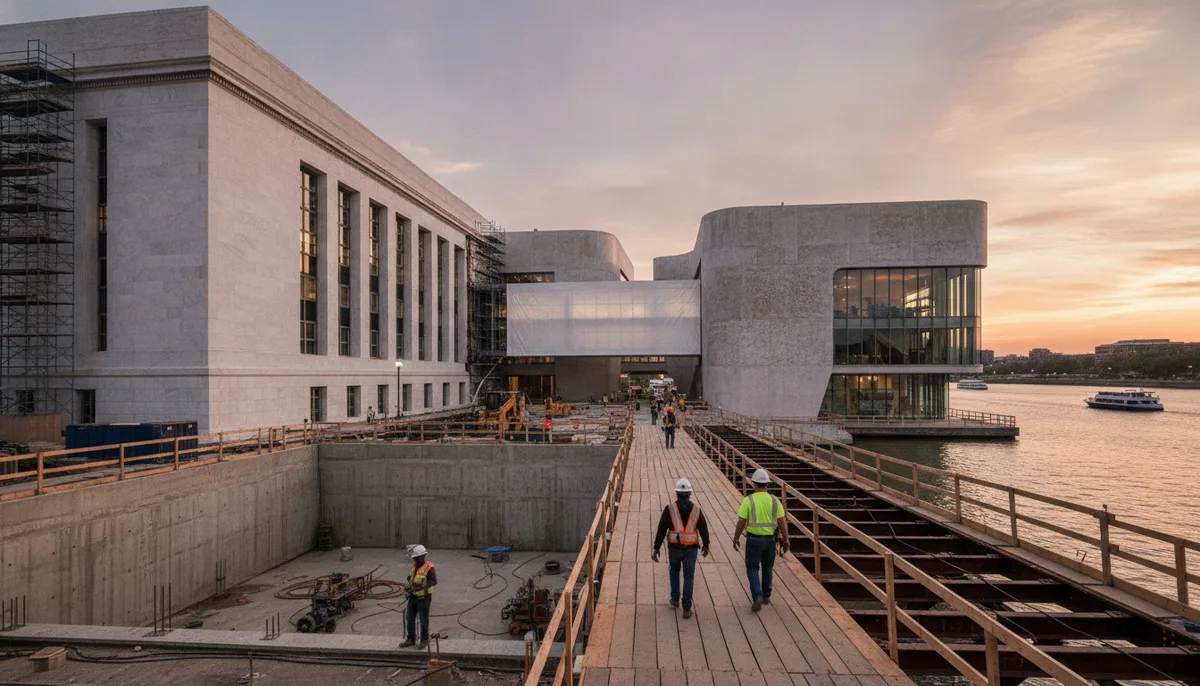
Renovate or Rebuild? Lessons from the Kennedy Center’s $257 Million Dilemma
The decision to breathe new life into an aging structure or level it to the ground is rarely simple. It is a high-stakes calculation involving structural integrity, financial forecasting, and historical sentiment. This dilemma recently reached the highest levels of American infrastructure with the Kennedy Center for the Performing Arts. After more than half a century as a cultural beacon, the Center was shuttered for a planned $257 million overhaul—only for the current administration to suggest that total demolition might be the more pragmatic path.
For the average homeowner or real estate investor, the scale is different, but the fundamental questions remain the same. "I sit with homeowners regularly who’ve already gotten two or three contractor opinions and still don’t know whether to fix what they have or start over," says contractor Dylan Milroy. That uncertainty isn't just stressful; it's expensive.
Whether you are looking at a landmark institution or a mid-century fixer-upper, understanding the "bones" of a building is the first step in deciding its fate.
The 50% Rule: A Professional Line in the Sand
In the world of professional contracting and structural engineering, the "50% rule" serves as a primary guidepost. This benchmark suggests that if the cost to repair and modernize a structure exceeds 50% of the cost to replace it entirely, demolition is the most rational path forward.
Contractor Kameron Khan emphasizes that this isn't just a suggestion—it's a safeguard against the "sunk cost" fallacy. "Professionals don’t guess when it comes to repair versus demolish decisions," Khan says. "That number gives you a clear line in the sand, and it applies whether you’re looking at a family home or a building the size of the Kennedy Center."
The logic behind the 50% rule is rooted in the "unknown unknowns." When you renovate an old building, you inevitably uncover hidden issues—outdated wiring, termite damage, or mold—that weren't visible during the initial inspection. If your starting budget is already at half the cost of a new build, these surprises can easily push the project past the point of profitability.
If you are evaluating a potential purchase, Mastering the Open House: A Strategic Guide for Buyers, Sellers, and Real Estate Professionals can help you identify these red flags before you commit to a contract.
Reading the Bones: Structural Red Flags
A building’s "bones" consist of its foundation, load-bearing walls, and roof framing. If these are sound, almost anything else can be fixed. However, when the bones begin to fail, the cost of "repair" often mirrors the cost of "reconstruction."
According to structural experts, a building may be too far gone if you observe:
- Severe Foundation Failure: Deep, wide cracks or a foundation that is visibly sinking or shifting.
- Sagging Rooflines: This often indicates that the load-bearing walls have shifted or the trusses have lost their structural integrity.
- Extensive Rot or Mold: When moisture has compromised the framing of the house, the "bones" are no longer capable of supporting the weight of the structure safely.
"Those are not maintenance issues," says Khan. "Those are the building telling you it’s losing the fight." For homeowners, identifying these issues early requires the right tools.
Using a high-quality level can help you determine if a floor is merely "settled" or if the entire structure is leaning—a critical distinction when calculating repair costs.
The Hidden Cost of Compliance: The Code Cascade
One of the most overlooked aspects of the renovate-vs-rebuild debate is the impact of modern building codes. Many jurisdictions require that if a renovation exceeds a certain percentage of the home’s value, the entire structure must be brought up to current International Building Code (IBC) standards.
This "code cascade" can turn a simple cosmetic update into a financial nightmare. General contractor Mikko Pasanen notes that updates can trigger mandatory retrofits for:
- Higher Insulation Ratings: Requiring you to strip walls to the studs.
- ADA Compliance: Particularly relevant for commercial spaces or multi-family units.
- Seismic Retrofitting: Essential in earthquake-prone zones, which can involve massive structural reinforcements.
"When a building’s major systems are so outdated that updates trigger a cascade of mandatory code overhauls, you end up throwing good money after bad," says Pasanen. This is why the Kennedy Center project is so complex; an internal email obtained by NPR listed necessary upgrades to HVAC, safety, and electrical systems—systems that, once touched, must meet 2026 safety standards, not 1971 ones.
The Case for Preservation: When History Outweighs the Spreadsheet
While the 50% rule is a solid financial guide, it isn't the only factor. Historic buildings often possess what home renovator Herman Hartanto calls "unreplicable character."
"Historic buildings possess the unique qualities of excellent craftsmanship and rich history," Hartanto says. "Even though costly to repair, it is worth it to preserve the character of a structure that cannot be replicated."
In the case of the Kennedy Center, the $257 million allocated by Congress isn't just for "strategic painting" and new carpeting; it is an investment in a cultural monument. For a homeowner, this might mean saving a Victorian-era porch or original hand-carved banisters. In these instances, the value is emotional and aesthetic rather than purely mathematical.
However, even in preservation, you must be realistic about safety. Assessing moisture levels in old wood is vital to ensure that "historic" doesn't mean "hazardous."
Strategic Renovations: Knowing Where to Stop
Architectural engineer Andy Gibbs suggests that the decision doesn't always have to be an all-or-nothing choice. "Unless you are buying a $2 million Malibu ‘teardown’ to build a $5 million house overlooking the ocean, rebuilding only the failed or obsolete portions usually makes more financial sense than demolishing everything," he says.
This "surgical" approach involves:
- Stripping to the Studs: Keeping the sound framing but replacing all systems (plumbing, electrical, HVAC).
- Foundation Underpinning: Strengthening the existing foundation rather than pouring a new one.
- Partial Demolition: Removing a failing wing or addition while keeping the original, sound structure.
By focusing the budget on the "failed or obsolete portions," owners can maintain the home's footprint and some of its original materials while ensuring the major systems are modern and safe. This is often the path taken for buildings like the Kennedy Center, where the Concert Hall stage reflooring and seating upgrades provide high impact without requiring the destruction of the iconic exterior.
Navigating the Uncertainty: How to Choose
If you find yourself standing in a building, wondering if you should grab a hammer or a wrecking ball, follow this professional workflow:
1. Get a Structural Audit
Before talking to a designer or an architect, hire a structural engineer. They have no stake in the renovation and will give you an unbiased report on the foundation and framing.
2. Run the 50% Calculation
Get a firm quote for a total rebuild of a similar square footage. Then, get a comprehensive quote for your desired renovations. If the renovation quote is $300,000 and a new build is $500,000, you are well past the 50% mark and should seriously consider demolition.
3. Check for "Code Triggers"
Consult with your local building department. Ask specifically: "At what point does a renovation require me to bring the entire building up to current IBC standards?" This single question can change your budget by tens of thousands of dollars.
4. Consider the "Soul" of the Property
If the building has historical significance or architectural details that are no longer produced, the extra cost of renovation may be a justified investment in the property’s long-term resale value and character.
Conclusion
The debate surrounding the Kennedy Center serves as a high-profile reminder that buildings are more than just wood and stone—they are complex systems with finite lifespans. Whether you are managing a national landmark or your first fixer-upper, the choice to renovate or demolish should be driven by data, not just dreams. By respecting the 50% rule, identifying structural red flags, and understanding the weight of modern building codes, you can ensure that your investment—whatever the scale—stands on a solid foundation for years to come.